
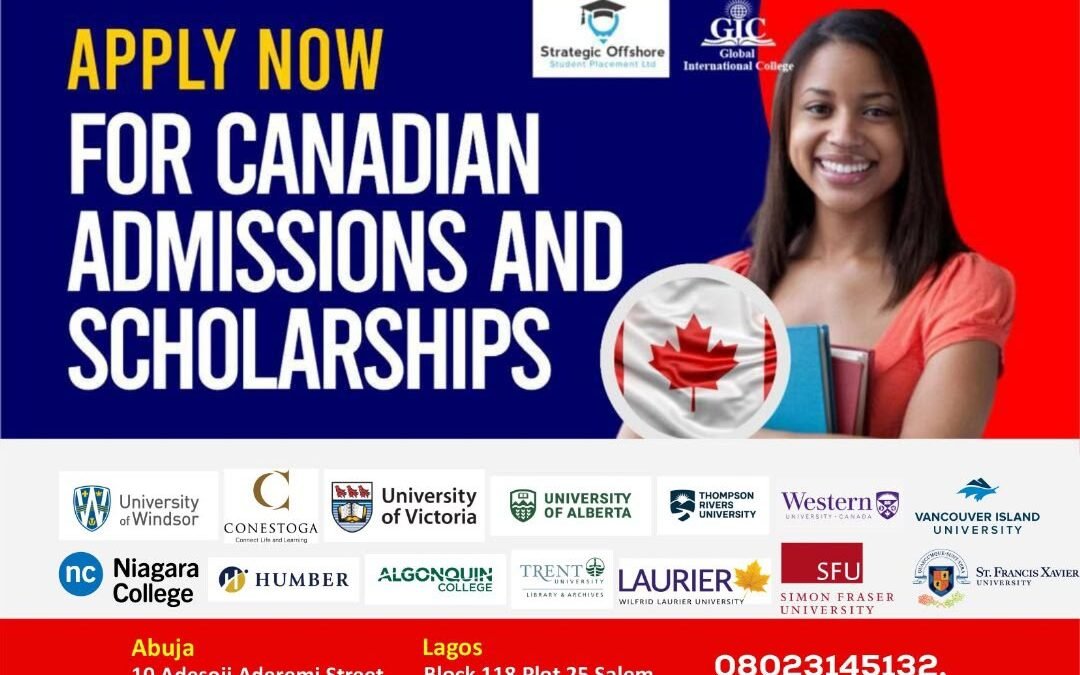
For many students in Nigeria, the dream of studying in Canada begins with a simple question: How can I gain admission to study in Canada?
The answer involves much more than finding a university and submitting an application.
Students need to understand their academic pathway, choose an appropriate programme, identify suitable institutions, prepare their documents, explore scholarship opportunities, understand the cost of studying in Canada and eventually prepare for the Canadian study permit process.
For students still in secondary school, the journey can begin even earlier.
At Global International College, academic preparation and university planning are connected. Through its Sixth Form pathway and Strategic Offshore Placements, an arm of Global International College, students can receive academic preparation and later support with university placement, scholarship opportunities and the admission process.
This guide explains what Nigerian students need to know about study in Canada from Nigeria, while showing how proper preparation can make the journey to a Canadian university more structured.
Why Study in Canada?
Canada has become a popular destination for international students because of its established universities and colleges, multicultural environment and opportunities for students to gain an international education.
However, choosing to study in Canada for international students should not be based simply on the popularity of the country.
The more important question is:
Is the Canadian education pathway suitable for your academic background, career goals and long-term plans?
This is why the process should start with understanding the student rather than immediately choosing a university.
A student’s academic results, intended field of study, budget, preferred location, future plans and eligibility requirements can all influence which options are appropriate.
Can Nigerian Students Study in Canada?
Yes. Students in Nigeria can apply to Canadian universities and colleges as international students if they meet the admission requirements of the institution and programme they are applying for.
The appropriate route depends on the student’s current qualification.
For example, students may apply after completing:
- WAEC or NECO
- IGCSE
- A-Levels
- A diploma or HND
- A bachelor’s degree when applying for postgraduate study
Canadian institutions determine their own admission requirements, so the requirements can differ depending on the programme and level of study.
For students applying through Strategic Offshore, academic results and transcripts form part of the information used to assess suitable options.
How to Study in Canada from Nigeria
The process can be viewed as a journey rather than one application.
A typical pathway involves:
Academic preparation → Programme planning → Institution selection → Admission application → Scholarship assessment → Admission → Study permit → Travel and university
The earlier a student begins planning, the more time there is to make informed decisions and prepare the required documents.
This is particularly important for students who want to explore competitive scholarships, because some major awards have specific eligibility requirements and deadlines.
Choosing the Right Programme to Study in Canada
One of the first decisions is deciding what you want to study.
Students can choose from a wide range of academic programmes in Canada. However, the important question is not simply:
“What course is popular?”
It is:
“What programme is appropriate for this student’s academic background and future goals?”
For example, a student’s previous subjects, academic performance, intended career, budget and future plans can all influence the options available to them.
The institution and programme also matter because admission requirements and post-study opportunities can differ.
This is one of the areas where professional assessment can make the process easier.
Strategic Offshore Placements assesses a student’s profile, preferred programme, intake and education budget before recommending suitable institutions and scholarship opportunities.
Rather than asking a student to search through hundreds of institutions alone, the objective is to narrow the options to those that are appropriate for the student’s circumstances.
Canadian Universities for International Students
Canada has many universities and colleges that accept international students.
But being a Canadian institution does not automatically mean that it is the right choice for every student.
The appropriate institution can depend on:
- the student’s academic qualification
- programme requirements
- admission criteria
- tuition budget
- scholarship opportunities
- location
- intended intake
- future academic and career plans
Strategic Offshore’s Canadian placement process includes programme selection, applications to Canadian institutions, document preparation, scholarship review and study-permit guidance.
This means the process can begin with the student’s goals rather than with a random list of universities.
What Are the Admission Requirements to Study in Canada?
Admission requirements vary between institutions and programmes.
However, international applicants should generally expect to provide academic and personal documentation relevant to their application.
Depending on the student’s level of study, this can include:
- International passport
- Birth certificate or declaration of age
- WAEC, NECO, IGCSE, A-Level or equivalent results
- Academic transcripts
- Degree, diploma or other previous qualifications
- CV where applicable
- Personal statement or statement of purpose
- Academic or professional references where required
- English-language test results or other assessments where required
Postgraduate applicants may also need university transcripts and evidence of previous degrees or qualifications.
The exact requirements should always be confirmed for the student’s intended institution and programme.
How Much Does It Cost to Study in Canada?
The cost of studying in Canada varies considerably depending on the institution, programme and level of study.
As a practical planning range, international undergraduate tuition can be approximately CAD $13,000–$40,000 per year, although some programmes and institutions may fall outside this range.
Tuition is only one part of the financial plan.
Students also need to consider:
- accommodation
- food
- transportation
- health insurance
- books and study materials
- personal expenses
- travel
- other university-related costs
Canada’s study-permit requirements also require applicants to demonstrate that they have sufficient funds for tuition, living expenses and return transportation. (Canada)
This is why the budget should be considered before selecting an institution.
A university may offer an attractive programme, but the overall cost needs to be realistic for the student and family.
Scholarships to Study in Canada
One of the most important questions parents and students ask is:
“Are there scholarships to study in Canada?”
Yes. Canadian universities offer different scholarships and awards to international students, but eligibility, value and deadlines vary.
Some awards are particularly significant for high-achieving students.
Lester B. Pearson International Scholarship
The University of Toronto’s Lester B. Pearson International Scholarship is an example of a highly competitive international undergraduate scholarship. It is designed for international students entering undergraduate study and involves nomination by the student’s secondary school.
For the current 2027 intake information, the scholarship provides support covering tuition, books, incidental fees and full residence support for four years. (Canada)
This example is particularly relevant to students still in secondary school because it demonstrates that scholarship preparation can begin before university admission.
York University Scholarships
York University also offers significant scholarships for international students.
Its current scholarship information includes the President’s International Scholarship of Excellence, valued at CAD $180,000 over four years, for qualifying international high-school applicants who demonstrate academic excellence alongside leadership, volunteer work and extracurricular achievement. (York University Future Students)
York also lists the Glendon International Excellence Scholarship, valued at CAD $40,000 over four years, for qualifying international students admitted to Glendon with strong academic standing. (York University Future Students)
University of Calgary
The University of Calgary also offers international entrance scholarship opportunities for qualifying international undergraduate students.
These examples show why students should not wait until the last moment before thinking about scholarships.
The important question is not simply “Which scholarships exist?”
It is:
“Which scholarship opportunities match this student’s academic profile, intended programme and university pathway?”
Strategic Offshore Placements includes scholarship review as part of its Canadian admission support.
Scholarship values, eligibility requirements and deadlines can change between intakes, so opportunities should always be confirmed for the student’s intended year of entry.
Can I Study in Canada After A-Levels?
Yes.
A-Levels can provide a strong academic pathway for students planning to continue to university abroad.
For students who already know that they want an international university education, the advantage of beginning university planning during Sixth Form is that academic preparation and university preparation can happen together.
This is important because A-Levels should not simply be viewed as examinations to pass before moving on to university.
They can be part of a broader university pathway.
At Global International College, the Sixth Form experience is designed around focused academic preparation while helping students begin thinking about their next stage beyond secondary education. The college’s approach connects Sixth Form preparation with the student’s longer-term university journey.
Your Canadian University Journey Can Start at Global International College
For parents considering A Level schools in Lagos, one important question is:
What happens after the A-Levels?
Choosing a school should not only be about where a student will sit examinations.
It should also be about whether the school is preparing the student for what comes next.
At Global International College, students can follow a structured academic pathway while beginning to think about university opportunities early.
This is particularly relevant for students who want to study abroad after A-Levels.
Instead of completing Sixth Form and only afterwards beginning to think about university applications, students can start understanding their options earlier.
That can give them more time to:
- prepare academically
- understand university requirements
- consider appropriate programmes
- identify potential scholarship opportunities
- prepare relevant documents
- plan financially
- work towards their intended university destination
This is part of the reason the choice of A Level schools in Lagos matters.
The goal should not simply be to find an A-Level centre.
It should be to find an academic environment that understands where the student is trying to go next.
From Global International College to a Canadian University
The pathway can be understood simply:
Global International College
↓
Academic Preparation
↓
University Pathway Planning
↓
Strategic Offshore Placements
↓
Canadian University Admission
↓
Scholarship Opportunities
↓
Study Permit Guidance
↓
Canadian University
Strategic Offshore Placements is an arm of Global International College and supports students with Canadian programme selection, applications, document preparation, scholarship review and study-permit guidance.
This creates a connection between school preparation and university placement.
For a student, that means the journey does not have to begin only after completing secondary school.
It can begin much earlier.
What Is Strategic Offshore Placements?
Strategic Offshore Placements supports students who want to pursue university education internationally.
For Canadian applications, the team can assist with:
- assessing the student’s academic profile
- identifying suitable programme options
- identifying suitable Canadian institutions
- preparing admission applications
- supporting document preparation
- reviewing scholarship opportunities
- guiding students through the study-permit stage
The process begins with information about the student’s academic results, preferred programme and intake, CV where applicable and education budget. The team then assesses the student’s profile and recommends suitable institutions and scholarship options.
The purpose is to make the process more organised and less overwhelming for students and parents.
Can International Students Work While Studying in Canada?
Eligible international students may be able to work while studying in Canada.
Under current Canadian rules, eligible students can generally work up to 24 hours per week off campus during regular academic sessions and can work unlimited hours during scheduled breaks, subject to the conditions that apply to their situation. (Canada)
Students should not assume that simply having a study permit automatically gives them unrestricted permission to work. They must meet the applicable eligibility requirements and follow the conditions of their permit.
This can be an important part of understanding student life in Canada, but the primary purpose of studying should remain academic progress and completion of the programme.
Can Students Stay in Canada After Graduation?
This is another important question for students considering study in Canada for international students.
Graduation does not automatically give a student permanent residence in Canada.
However, eligible graduates may be able to apply for a Post-Graduation Work Permit (PGWP), which can allow them to gain Canadian work experience after completing their studies.
Eligibility depends on factors including the institution and programme, and meeting the applicable PGWP requirements. Canada specifically states that graduating from a designated learning institution does not automatically make someone eligible for a PGWP. (Canada)
For some programmes, additional language or field-of-study requirements can apply. (Canada)
The length of a PGWP can also depend on the level and duration of the programme and other applicable factors. (Canada)
After graduation, eligible graduates may also explore other immigration options if they meet the requirements. However, studying in Canada should never be presented as an automatic route to permanent residence.
This is another reason why choosing the right programme and institution should be part of the planning process from the beginning.
When Should a Nigerian Student Start Planning to Study in Canada?
One of the biggest mistakes students can make is waiting until the last minute.
Starting early gives students more time to:
- assess their academic profile
- determine suitable university pathways
- prepare for admission requirements
- identify scholarship opportunities
- prepare documents
- understand the financial requirements
- meet application deadlines
- prepare for the study-permit process
Strategic Offshore’s Canadian admission guidance also recommends starting applications early because deadlines vary between institutions and programmes.
For students still in secondary school, this means university planning does not need to wait until the final examination is over.
Why Choose an A-Level College in Lagos That Thinks Beyond the Examination?
When parents search for A Level schools in Nigeria, best A Level schools, or an A Level college in Lagos, it is natural to compare academic results, subjects, facilities and fees.
But there is another question worth asking:
What happens after the student completes the A-Levels?
A strong academic pathway should prepare students not only for examinations but also for the next stage of their education.
Global International College has more than 25 years of experience in education, and its approach connects academic preparation with university planning and international opportunities.
For students interested in studying abroad, this means the conversation can begin early — while the student is still preparing academically.
The objective is to help students move from:
Secondary education → A-Levels → University planning → International admission → University
rather than treating each stage as a completely separate process.
Why Start Your Journey with Global International College?
If your child is still deciding where to complete Sixth Form, the decision should go beyond finding an A Level school in Lagos.
Consider what the school can offer before, during and after the A-Level journey.
At Global International College, students receive focused Sixth Form academic preparation while being introduced to the wider university pathway.
Through Strategic Offshore Placements, the journey can continue from academic preparation to international university placement.
This means parents are not simply looking for an A Level college in Nigeria.
They are looking for an educational pathway that can help their child prepare for university.
Frequently Asked Questions
Can I study in Canada from Nigeria?
Yes. Nigerian students can apply to Canadian universities and colleges as international students if they meet the requirements of their chosen institution and programme.
Can I study in Canada after WAEC?
Yes. Students with secondary-school qualifications such as WAEC or equivalent qualifications may apply to appropriate Canadian post-secondary programmes, subject to the institution’s admission requirements.
Can I study in Canada after A-Levels?
Yes. A-Levels can be used as part of the academic pathway for university admission, depending on the requirements of the institution and programme.
How much does it cost to study in Canada?
International undergraduate tuition can vary significantly. A practical planning range is approximately CAD $13,000–$40,000 per year, with living expenses and other costs considered separately.
Are there scholarships to study in Canada?
Yes. Canadian universities offer different scholarships for international students. Some are highly competitive and can provide substantial financial support.
Can students work while studying in Canada?
Eligible international students may be able to work while studying, subject to Canada’s current rules and the conditions of their study permit. (Canada)
Can students work in Canada after graduation?
Eligible graduates may qualify for a Post-Graduation Work Permit, depending on the programme, institution and other requirements. (Canada)
Does studying in Canada automatically give permanent residence?
No. Graduation does not automatically provide permanent residence. Eligible graduates may explore applicable immigration pathways after completing their studies.
Can Strategic Offshore help me choose a Canadian university?
Yes. Strategic Offshore Placements assesses the student’s academic profile, preferred programme, intake and budget and can recommend suitable institutions and scholarship opportunities as part of its placement support.
Start Preparing for Your Future University Today
Studying in Canada is not simply about getting an admission letter.
It is about making the right decisions before the application is submitted.
Your academic preparation, programme choice, university selection, scholarship opportunities, finances and study-permit preparation all form part of the journey.
That is why starting early matters.
If your child is currently in secondary school or preparing for A-Levels and has plans to study abroad, Global International College can provide the academic foundation while Strategic Offshore Placements supports the transition towards international university admission.
Ready to begin?
Join Global International College and start building your university pathway from today.
📍 Block 118, Plot 25 Salem Street, Ikate Elegushi, Lekki, Lagos State
📞 0707 218 8282
💬 WhatsApp: 0707 218 8282
Speak With Our Team
Strategic Offshore Student Placement
Through Global International College
📞 Amaka: 09039186004
Your A-Levels are not the destination. They can be the beginning of your university journey

Recent Comments